1954
By popular demand Elvis performed again at the Palladium Club, Houston.
https://www.scottymoore.net/houston.html#PAL

He even sent a telegram to his parents: ” Hi Babies, Here’s the money to pay the bills, Don’t tell no one how much I sent I will send more next week. There is a card in the mail. Love Elvis. “

1955
Bill Haley‘s “Rock Around The Clock” reaches #1 in the UK and is considered to be the first Rock and Roll record to accomplish that feat.
Elvis performed at the Louisiana Hayride, Municipal Auditorium, Shreveport.
https://www.scottymoore.net/shreveport.html

1956
Big band leader and trombone soloist Tommy Dorsey died.
Elvis paid a visit to his Grandfather Jessie D Presley with wife Vera, at 4008 Beaver St (photo below) and he didn’t arrive empty handed. Elvis brought with him what is reportedly the very first car he ever gave away, a brand new 1957 Ford Fairlane with a new TV set in the trunk and handed over $100 to Vera Presley (nee Leftwich) his step Grandmother.

Then Elvis drove back to Memphis, visiting the Colonel on the way.
1958
: Hotel Grunwald in Bad Nauheim, Germany

1959
in Bad Nauheim, Germany

Elvis mails a love letter to Anita Wood

1960
Elvis Presley’s single “Are You Lonesome Tonight” hit #1 in the U.S.

Wild in the Country Film Production; Elvis flew to Las Vegas for the weekend with Charlie Hodge, Joe Esposito, Red West and Alan Fortas.
1961
Kid Galahad Film Production
1968
Goldwyn Studios – Hollywood, California
Charro (Track Repairs & Orchestral Overdub) WPA1 8091

1970
Lisa Marie, Elvis & Priscilla at their Hillcrest home in Los Angeles sometime between November 26-30, 1970

1971
Elvis returned to Palm Springs, after his week in Los Angeles, and stayed there until December 3.
November 26, 1972
Here you can see a image of a check Elvis wrote in 1972 to the Sugar Ray Youth Fund, a charity started by famous boxer Sugar Ray Robinson. Founded in 1969, the Foundation provides year-round program activities related to sports, fine arts and the performing arts. Robinson said, ‘By offering youth opportunities to express themselves through sports, artistic activities and cultural enrichment, we can get to the children who are not reached by other methods and help keep them out of trouble’.

1973
John Rostill former bassist with The Shadows died after being electrocuted at his home recording studio. A local newspaper ran the headline, ‘Pop musician dies, guitar apparent cause’. After the break up of The Shadows Rostill worked with Tom Jones and wrote songs covered by Elvis Presley and Olivia Newton-John.
1976
Elvis performed at the Memorial Coliseum, Portland, Oregon.

CONCERT DATE: November 26, 1976 (8:30 pm) Portland, OR.
The Oregonian
November 27, 1976
Elvis Still Rock King To His Fans
By John Wenderborn
Count the "kings" of entertainment: There's Benny Goodman, the King of Swing, and Frank Sinatra, just the "king" a singer with a style non pareil.
But the king of rock and roll is still Elvis Presley; his throne has yet to be threatened and he's been at it longer than most, something like 22 years now.
Elvis returned to Portland's Memorial Coliseum Friday night for the first time in about two (maybe three) years and staged a typical Las Vegas show. Except that 11,000 enthusiastic, camera-toting fans were on hand Friday a supposed to the hundreds who view his Nevada shows
Presley was in his usual good humor throughout, tossing silken scarves to those ladies who could break past the super-tight security barrier and making small jokes with the members of his two-dozen person entourage onstage.
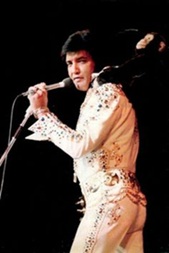
He was attired in a swashbuckling white suit with plenty of embroidered glitter around the jacket. And for those who've been reading reports of Presley's battle with the calories, he looked trim enough to look healthy.
If anything, his face has lost that patented sneer. When he smiled it was a gentle smile. And Elvis is either 40 or 41
The show opened with short segments by the Hilton horns, JD Sumner and the Stamps, the Sweet Inspirations and Jackie Kahane, a comic.
The Sumner group was excellent gospel, it a bit Las Vegas. The Inspirations presented a rhythm and blues and soul portion that also was good. But Kahane was excellent if a bit conservative in his comic approach. He was very funny without being blue.
But the show was Elvis, and while it seemed a bit softer than a past performances in Portland it was nevertheless a good Elvis concert. He split the music between old and new stuff and, of course, received the biggest accolades for tunes like "Jailhouse Rock," which dates back to his mid-1950s roots.
There was enough his swiveling to keep the swooners swooning while he passed out like 60 pastel scarves.
It would be a tossup to predict whether the fans were there to listen to music, see Elvis the idol or relive high school rock and roll days.
Presley certainly appealed to catch of those reasons, but his music was stable enough to make that the major reason. His voice is a tender baritone, especially on the beautifully done "Hawaiian Wedding Song?". He played guitar, but did little more than a chord along with the band behind him.
He was ably helped by 10 backup singers, a seven-piece rock and roll band - with James Burton playing lead guitar, one of the real greats in this music - and the six horns.
He generously gave room to other solo performers in the backing group, including Sumner, whose bass voice has got to be the deepest one in music. When he got to the bottom of his voice, it actually rattled the huge bass-powered speakers and amplifiers in the building.
Presley was on about 90 minutes, spreading his music between slow, gospel and short versions of his old rock and roll hits. There's no question that the man is still in the legend category. He holds a position in entertainment only few others can claim, including Frank Sinatra and the Beatles.
He's active enough to keep all hands happy, and the feeling is always that elvis will still be filling the Coliseum 20 years from now.

2002
Citing “irreconcilable differences”, actor Nicolas Cage files for divorce from Lisa Marie Presley. The petition was granted on May 27, 2004, nearly a year and a half later, ending a marriage that lasted less than four months.
2008
For the eighth straight year, revenue for North American terrestrial radio declined, with figures showing a seven percent drop from last year. The entire industry had its worst year financially since 1954.
2016
https://www.lancashiretelegraph.co.uk/l ... ter_Arena/

There can’t be many artists who would sell out an arena 40 years after their death but then there aren’t, nor have there ever, been many artists like Elvis Presley.
The premise of the show is simple. Take footage of vintage Elvis concert performances, show it on a big screen and get the orchestra to accompany the great man.
In reality it’s a far more complex – and at times – thrilling experience.
It’s all too easy to be sceptical about Elvis, his legacy tarnished slightly by the thousands of karaoke singers and his love of rhinestones and a jumpsuit.
But what this show does is reaffirm his peerlessness as an artist and singer.
Bear in mind that playing live was a full orchestra and at times even they struggled to keep up with the power and the majesty of the King in full cry.
The Royal Philharmonic Orchestra has made two albums accompanying Elvis and many of the songs featured in the two hour show.
Priscilla Presley, resplendent in velvet gown, was on hand to introduce proceedings – she has played a major part in the project getting off the ground.
The setlist wasn’t just a greatest hits either. Highlights include a lesser known song, Don’t, from early in Elvis’ career but it was the blockbusters like In the Ghetto, Suspicious Minds and the emotional American Trilogy which got the best response.
There was a slightly surreal moment – as if watching a dead rock and roll legend perform ‘live’ in front of your eyes isn’t surreal enough – when Priscilla walked along the front row asking stunned audience members their name and where they came from. Faced with a 10-year-old Elvis impersonator in full garb made by his gran, even she was taken aback.
But it was the music that everyone had come for and it didn’t disappoint.
The RPO were magnificent adding power and, when needed, lightness to the songs. The backing singers did a sterling job and for a rock and roll section it was great to see the musicians singing along and at one point leaping out of their seats and jiving along to the music.
The packed crowd was a mixture of the worshippers, the curious and possibly the sceptics.
By the end, the show left no-one in any doubt. Elvis is and always will be the king of rock and roll – and so much more besides.
2017
The Music Diaries | Racism allegation contradicts Presley's life
Last week's Music Diaries gave a short insight into Elvis Presley's spiritual leanings. His association with gospel concerts and gospel recordings as a teenager portrayed him as a godly man who would be the last to indulge in racism. Yet, I have grown up from a youth knowing that Presley was condemned by many Jamaicans for certain derogatory comments in the late 1950s.
The official website Elvis Australia - Elvis and Racism, the ultimate definitive guide, quotes a source (which they do not reveal) that accused Presley of saying that "the only thing Negroes can do for me is shine my shoes and buy my records". But the same website has produced glaring evidence to refute that comment and render it fallacious.
Photographed in a jovial mood with several outstanding black entertainers of that time, including female gospel singer Mahalia Jackson, Brook Benton, Jackie Wilson, Sammy Davis Jr, Johnny Mathis, Fats Domino, and B.B. King, Presley was portrayed as a white man who had a black heart. The website states that "in heavily segregated Memphis of that day, Presley was regularly seen at black-only events".
The white boy thus became hooked on the music of pioneering black artistes being played on the radio, got immersed in black Memphis blues clubs, and absorbed the music of local impoverished black communities. It was to Memphis that his father had moved the family while Elvis was still a pre-teen to escape the poverty that they were experiencing in Mississippi, where he was born into a poor sharecropping family on January 8, 1935.
I have grown with the music and kept abreast of Presley's development and easily appreciate that most of what was said about Presley and his racist leanings was nonsense. For whatever reason, from my viewpoint, he came across with a 'black sound' on That's All Right Mama in July of 1954 for Sun Records. It was, therefore, inconsistent with his upbringing that Presley could have indulged in such misdeeds.
He covered the genres of pop, ballads, rockabilly, country, blues, Rhythm and Blues, gospel, and Rock 'n' Roll. It was the last genre that brought the man, who later became known as The King Of Rock 'n' Roll, into the public limelight after Radio Corporation of America (RCA) bought his contract from Sun Records.
The 'Elvis Presley commemorative issue' album lists his first five recordings for RCA (all number one hits on the Billboard and Cashbox charts) as Heartbreak Hotel, I Want You I Need You I Love You, Hound Dog, Don't Be Cruel, and Love Me Tender, in that order, all recorded between April and August 1956 in the Rock 'n' Roll and ballad genres. He followed up with four more number-one Rock 'n' Roll songs consecutively - Too Much, All Shook Up, Teddy Bear and Jailhouse Rock - on the same charts, between September 1956 and April 1957.
But of all the genres that Presley has attempted, perhaps his ballad songs have presented us with some of the most haunting love verses. How could we ever forget It's Now Or Never, That's When Your Heartaches Begin, and Are You Lonesome Tonight. The mid-song soliloquy in the last song is worth reciting:
"I wonder if you're lonesome tonight
And each must play a part
Fate had me playing in love, you as my sweetheart
Act one was when we met,
I loved you at first glance
You read your lines so clearly and never missed a cue
Then came act two
You seemed to change
And you acted strange
And why I'll never know
Honey, you lied when you said you loved me
And I had no cause to doubt you
But I'd rather go on hearing your lies
Than go on living without you."
2018
https://blabbermouth.net/news/robert-pl ... arty-video
ROBERT PLANT Performs ELVIS PRESLEY Covers At Ex-Wife’s 70th …
BLABBERMOUTH.NET–
Robert joined local band THE HAYRIDERS for three Elvis Presley songs: “One Night With You”, “Little Sister” and “A Big Hunk O’ Love”.

comeback special, 50 years later
The electrifying 1968 TV performance made The King cool again — at least for the moment.
by Mark Carlson
Sunday, November 25, 2018
Just how far removed from cultural relevance was Elvis Presley in 1968?
When Singer — the maker of sewing machines — brokered a deal with NBC to sponsor three TV music specials, the company’s go-to artist list consisted of Hawaiian pop crooner Don Ho, Las Vegas king of glitz Liberace and Presley.
If that weren’t enough, Presley’s manager, Col. Tom Parker, envisioned his client’s show as a traditional holiday special. At his first meeting with Steve Binder, who produced and directed the special, Parker handed him an audiotape containing 20 Presley recordings of Christmas songs; on the box was a picture of the King, a holiday wreath behind him.
All that was missing was an ugly sweater.
“I thought, ‘This is not going to work,’ ” Binder said in an interview with The Times. “‘I don’t want to do some Andy Williams or Perry Como TV special.’ I thought it was over.”
Yet in mid-1968 when the negotiations were underway for Presley’s appearance on NBC the following December, Binder managed to forge a bond with the singer that resulted in him defying Parker, however briefly.
The result was a turning point in Presley’s career. Indeed the Singer-sponsored show “Elvis” was subsequently referred to as “The 1968 Comeback Special.” Over the course of one hour, a 33-year-old Presley galvanized TV audiences with electrifying performances that gave fans a persuasive reason to forgive him for nearly a decade’s worth of formulaic Hollywood B movies that enriched his (and Parker’s) bank accounts but virtually depleted his musical credibility.
“If there hadn’t been the ‘68 special, I’m not sure he’d occupy the place in rock music history he does today,” said Alanna Nash, a veteran music writer and author of “The Colonel: The Extraordinary Story of Colonel Tom Parker and Elvis Presley” published in 2004. “I saw it on the big screen this past summer in Denmark at an Elvis event I was doing. You just can’t take your eyes off him. He’s so magnetic. It’s such a miracle to watch him regain his confidence after those awful movies like ‘Easy Come, Easy Go.’
“What’s Greil Marcus’ famous quote about it? ‘It’s like watching a man find his way home again,’ ” Nash said. “That’s really what it is.”
To mark this year’s 50th anniversary of the show that first aired Dec. 3, 1968, Sony Legacy is issuing an expanded “Comeback Special” box set with five CDs and two Blu-ray discs, a set that goes well beyond the original single LP soundtrack and even beyond the 40th anniversary four-CD set with additional audio released in 2008.
The new set contains all the audio and video recorded for the show, which first included only about 47 minutes of performance material interspersed with the requisite 13 minutes of commercials for a one-hour prime-time TV show at that time. It also comes with an 80-page book with photos and other documentation of the show, plus a new oral history assembled from video/filmmaker Thom Zimny’s interviews for the recent HBO special “Elvis Presley — The Searcher.”
Subsequently, through a serendipitous fluke, the “Comeback Special” has usually been shown in a 90-minute director’s cut that Binder created, but which NBC originally rejected.
Along with several production numbers, the heart of the original special was an in-the-round performance sequence in which Elvis jammed and engaged in playful banter with his longtime band mates, guitarist Scotty Moore and drummer D.J. Fontana (bassist Bill Black had died three years earlier) along with other musicians in front of a small, live studio audience.
Dressed head to toe in a tight black leather suit, Presley exuded raw sexuality as he and the band worked their way through essentially ad-libbed renditions of songs including “That’s All Right,” “Jailhouse Rock,” “Don’t Be Cruel,” “Baby What You Want Me To Do,” “One Night” and “Lawdy, Miss Clawdy,” among many others.
Binder, now 85 and living in Ventura County, says despite his initial misgivings about the ideas Parker was bandying about early on, he was persuaded to take on the project by Bones Howe, the respected music engineer.
“If it wasn’t for Bones Howe, I never would have done it,” Binder said. “He said, ‘Steve, you’re crazy not to do this. I engineered an album with Elvis and I really think you’d hit it off with him.’”
A few years earlier, in 1964, Binder had directed one of the 1960s’ greatest rock-R&B specials, “The T.A.M.I. Show,” which captured vibrant live performances by James Brown, the Rolling Stones, the Beach Boys, Chuck Berry, Marvin Gaye and others, filmed at the Santa Monica Civic Auditorium.
But the subject of that show never came up when he met with Presley to talk about what his projected special might look like: “I was not curious enough to even ask him about that.”
The in-the-round portion of the show, which many consider to be the template for “MTV Unplugged” when it emerged a couple of decades later, was also the result of happenstance.
“He’d been renting a home in Beverly Hills at that time, but while we were rehearsing, he said, ‘How about me living in my dressing room while we’re making the show?’ If it hadn’t been for that, there would have been no acoustic sessions. How he unwound after rehearsals was he just jammed in his dressing room with whoever was around. That’s what triggered the idea. I thought ‘I’ve got to get a camera in here.’
“The Colonel wouldn’t allow me to bring a hand-held camera in, but I kept pleading with him day after day. He finally said, ‘I’ll let you re-create it out on stage, but I won’t guarantee I’ll let you use any of it,’ ” Binder said.
“It was Elvis who came to me and said, ‘Do you think we could get Scotty and D.J. to do this with me? He was so (mad) at Parker for breaking them up in the first place,” he said.
Binder loved the idea, and arranged for Moore and Fontana to be in that segment. It was the last time they ever played with the man they helped turn into a global cultural phenomenon 14 years earlier starting with revolutionary recordings they made with producer Sam Phillips at his Sun Studio in Memphis.
“We didn’t rehearse it,” Binder said of the onstage jam session. “Elvis just sat down with all those guys — they just came in and did it. They knew all the songs, all the ones he loved, and it was totally real. We got two (one-)hour sessions of him doing improv. The beauty of it for me was that not only was he honest, he forgot he was doing a show with Scotty and Bill, and they were just playing together again.”
You’d never know it from what came through the TV cameras, but Binder recalls that Elvis was uneasy about the show. “He was nervous as hell when we did this special,” he said. “When I worked with him, he was extremely unhappy with where his career had taken him. He wasn’t sure if he could come back.”
Presley needn’t have worried. The special triggered a rejuvenation of his career — some using even stronger terms for the event that paved the way for a new round of hits including “In the Ghetto,” “Suspicious Minds” and “Burning Love” and set the stage for his final years of work in Las Vegas.
“It was a resurrection in the way he came back stronger than ever,” said Greg Harris, president and CEO of the Rock and Roll Hall of Fame in Cleveland, which is hosting a session about the show with Binder on Dec. 2 of what he calls “Comeback Special Weekend” at the institution.
“This was pure unadulterated emotion and the essence of rock ‘n’ roll,” Harris said. “I think that learning the narrative of how it came together just gives us a better appreciation for Elvis’ true concern and his love and passion for the music.”
“Another really important part of this whole thing is how Binder was able to see what Elvis was doing in his downtime in his dressing room, find a way to actually incorporate it into the show and then capture that moment,” Harris added. “So many performers put a lot of time and effort into making their performances look perfect, and trying to make them look unrehearsed. One thing that makes this special so great is that it’s not perfect — it’s raw and it’s real and it’s fantastic.”
Binder and project partner Spencer Proffer, a music industry veteran, are planning a series of activities over the next year highlighting the “Comeback Special” and Binder’s role in its creation.
In August, special-event producer Fathom Events showed the special on some 2,000 screens, and next year Proffer says he and Binder are planning another session in which Binder will discuss the making of the show, during which he’ll be joined by guest musicians who will perform their takes on some of the songs, mixed in with the vintage footage of Presley on stage.
They’re also moving forward with a documentary film about Presley and Binder’s friendship to be directed by John Scheinfeld (“Chasing Trane: The John Coltrane Documentary”) to follow the Fathom screenings in 2020.
Proffer also persuaded Binder to expand a “modest” book he’d written about his experiences with Presley and the show into a more lavish coffee-table book they’re targeting for broader distribution next year. It’s titled “Comeback ‘68/Elvis — The Story of the Elvis Special.”
NBC is also getting into the act with a TV special revisiting Presley’s show assembled by veteran Grammy Awards telecast executive producer Ken Ehrlich, with contemporary musicians offering their renditions of the songs Presley sang that night 50 years ago. That special is slated to air early next year.
Proffer also is helping bring Nash’s biography of Parker to the big screen after years of negotiations with different parties interested in telling the tale.
One of the most significant facets of the whole ” ‘68 Comeback Special” story is that it’s one of the few instances in Presley’s life where he overruled Parker, who has been widely pilloried over the years for the way he managed the singer’s career, starting with the 50 percent management commission he collected — with Presley’s approval.
In addition to rejecting Parker’s original idea for the show to be a Christmas special, Elvis — and Binder — also found a way around Parker’s request that they include one Christmas song to be released as a single. Instead, they closed the show with a powerful original expression of social justice, “If I Can Dream,” written for him by W. Earl Brown, credited on the show for “special lyrics and vocal arrangements.”
“We became very close while working on the show,” Binder said. “Elvis once told me, ‘Steve, I never want to sing any more songs I don’t believe in…. I never want to make another movie I don’t believe in’ and going on and on and projecting into the future. He wanted to travel the world, experience things he never had the opportunity to do.
“I said, ‘Elvis I hear you, but I don’t know if you’re strong enough to stand up to the Colonel,’ ” Binder said. “He always pulled his power play over Elvis, and Elvis would humbly bow his head. He never stood up to him in any other confrontations. In the end, unfortunately, I was right.”
2019
Elvis Christmas tribute concert coming to Grand Bend
The London Free Press–
https://lfpress.com/entertainment/local ... grand-bend
Local fans of the music of Elvis Presley will be getting an early Christmas present this holiday season as Elvis tribute artist Steve Michaels …